
Long Range Shooting Chronograph: Radar vs Optical
Top-line velocity is not the number that decides a hit at 600-plus yards. A long range shooting chronograph earns its keep on precision: Extreme Spread and Standard Deviation data you can trust, not just a single average reading.
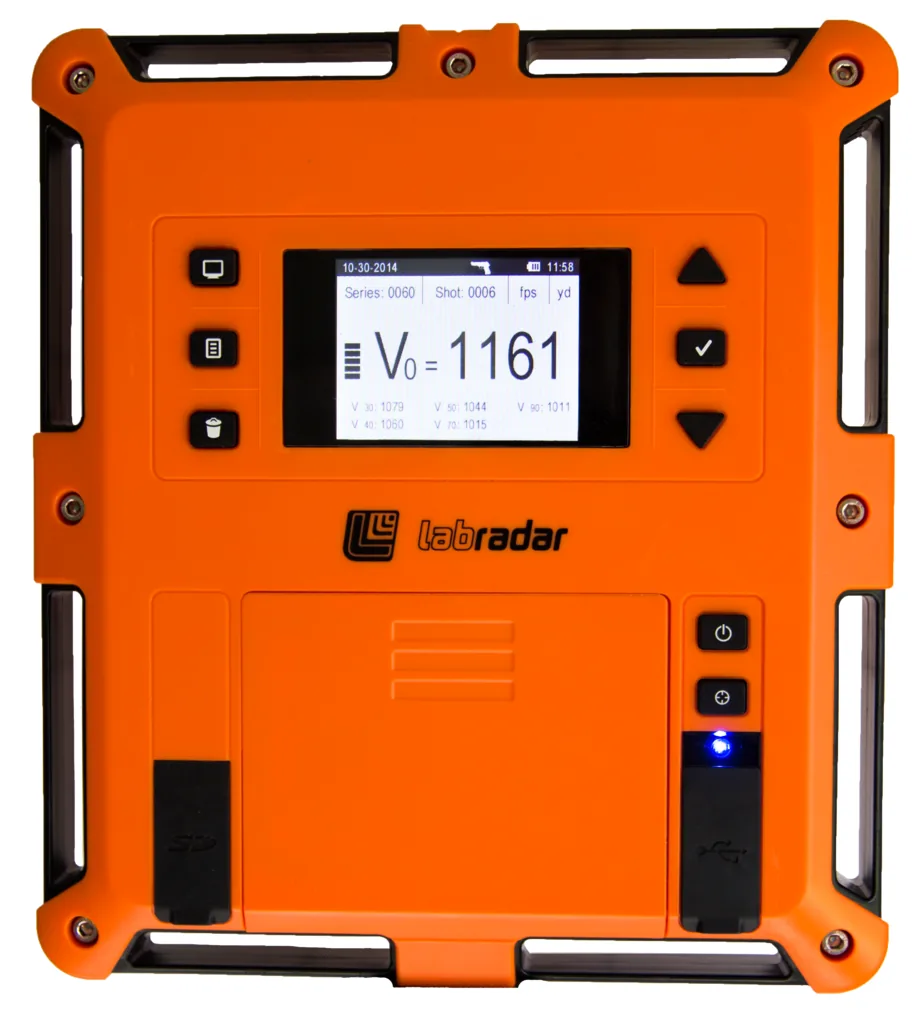
A chronograph built for long-range shooting needs to deliver reliable data when light conditions turn flat, and a readout of Extreme Spread (ES) and Standard Deviation (SD) — not just an average. Side-mounted Doppler radar chronographs, like the LabRadar stocked at Hunt Premium, read from beside the shooting position instead of downrange, capture velocity data at the muzzle and several set distances, and measure by Doppler radar, per the manufacturer’s published specification and product name.
01What Makes a Chronograph Suited for Long-Range Shooting?
Most chronograph shopping stops at one question: how fast is a load leaving the barrel? For ELR (extreme long-range) shooting, that’s the easy part of the picture. The harder, more useful question is how consistent that speed is, shot after shot — because it’s the inconsistency, not the average, that opens a group up the farther a load travels. Getting an accurate read of that spread, shot after shot, is the entire point of the tool.
Consider a hypothetical illustration: a load averaging 2,800 fps sounds precise on paper. But if, hypothetically, individual shots ran anywhere from a bit below to a bit above that average, that spread would compound into vertical dispersion the farther out the target sits — nearly invisible at 100 yards, potentially the difference between a hit and a miss well past 500. A chronograph suited to ELR work has to report that kind of spread with real precision — not bury it behind a single average-velocity readout. A chronograph doesn’t just measure top-line speed — it measures the consistency behind it.
- Average velocity alone does not predict precision at distance — shot-to-shot consistency does.
- Extreme Spread (ES) and Standard Deviation (SD) are the numbers that flag an inconsistent load before it costs precision downrange.
- Placement and light-dependency decide whether a chronograph holds that precision in real field conditions, not just at the bench.
Why Extreme Spread and Standard Deviation Matter More Than Average Velocity
Extreme Spread is the difference between the fastest and slowest shot in a string. Standard Deviation measures how tightly individual shots cluster around that number. Two loads can post the same average velocity, yet have very different ES and SD numbers underneath — one tight, one loose. Downrange, that gap in consistency becomes the gap in precision — a single average alone tells almost nothing about it.
This is why a chronograph built for long-range work needs to report Hi, Lo, Average, ES, and SD per string as standard output, not as a feature buried in a menu. The LabRadar Doppler radar chronograph carried at Hunt Premium records exactly that set — Hi, Lo, Average, ES, and SD — for every string, up to 100 shots per series across as many as 9,999 stored series, per its published specifications.
02Doppler Radar vs Optical vs Barrel-Mounted: Which Holds Precision at Distance?
Chronographs on the market use one of a few different measurement mechanisms, named here for context rather than compared point by point. This guide focuses on what’s verifiable about the mechanism Hunt Premium carries: the LabRadar, a Doppler radar unit that mounts beside the shooting position, per its published specification.
Per its published specification sheet, the LabRadar mounts on its own tripod to the side of the shooting position, with a clear line of sight to the projectile path. Per the product’s own name and published description, it measures by Doppler radar, and its rated operating window is 15°F to 110°F.
Other chronograph categories exist — sky-screen (optical) units and barrel-mounted (magnetic) units, a category that includes brands like MagnetoSpeed — each with its own mounting approach. This guide does not characterize their performance, since that would go beyond what Hunt Premium’s own catalog data can verify; readers comparing across categories should check each manufacturer’s own published specification sheet.
| LabRadar spec | Published value |
|---|---|
| Placement | Beside the shooting position, on its own tripod |
| Measurement method | Doppler radar |
| Operating window | 15°F to 110°F |
| Setup requirement | Clear side line of sight to the projectile path |
What the LabRadar’s Placement Means for a Long-Range Session
Per the manufacturer’s setup documentation, the unit mounts on its own tripod to the side of the shooting position, requiring a clear side line of sight to the projectile path and a standard ¼-20 tripod mount — the same setup at dawn, at dusk, or indoors.
What “Doppler Radar” Means as a Measurement Method
Per the product’s own name and its published description, the LabRadar measures velocity using Doppler radar. That’s the mechanism behind every spec cited in this guide — the 65 fps to 3,900 fps range, the 0.1% accuracy figure, and the multi-distance capture described below.
03What the Velocity Range and Accuracy Numbers Mean for Long-Range Load Development
Per its published specification sheet, the LabRadar Doppler radar chronograph tracks speeds from 65 fps to 3,900 fps at 0.1% accuracy — a spread wide enough to cover everything from airgun and archery setups to full-power ELR loads on the same unit. That published accuracy figure is tight enough, on paper, to separate a genuine load-to-load difference from measurement noise, rather than chasing numbers the unit itself can’t reliably resolve. [À VÉRIFIER: converting the 0.1% accuracy figure into an exact fps tolerance at a given velocity is a simple arithmetic derivation the manufacturer does not itself publish; read any such converted number as an editorial estimate, not a manufacturer-stated spec.]
That resolution matters specifically for ELR load development, where the goal is comparing small changes — a different powder charge, a new seating depth, a different lot of projectiles — against each other with real precision. One of the more useful features here is that every one of those comparisons gets an accurate, repeatable number attached to it, per the unit’s published accuracy spec. If the chronograph’s own measurement error is close to the size of the difference being tested, the resulting numbers describe the instrument, not the load.
The unit is rated for a 15°F to 110°F operating window and, per the product’s own name and published description, measures by Doppler radar — relevant for the cold, early-morning, or low-light sessions ELR shooters actually work in. A 3.5-inch display on the unit walks through the user-definable distance settings before a session starts, per the manufacturer’s setup documentation.
04How Multi-Distance Capture Helps Validate a Ballistic Drop Chart
Instead of reading only the muzzle, the LabRadar chronograph captures velocities at the muzzle and at up to five additional user-defined points, inside a tracking window of up to 100 yards. Comparing that measured velocity decay against what a ballistic solver predicted for a given bullet’s drag profile is one way to check a drop chart before trusting it well past that measured window.
A ballistic drop chart is only as good as the ballistic coefficient fed into the solver that built it. Manufacturer-published coefficients are averages and can drift from what a specific bullet, at a specific velocity, actually does in the air. Capturing real readings at the muzzle plus several downrange points — instead of a single number — gives a shooter an actual measured decay curve to compare against the solver’s modeled one, point by point, inside the chronograph’s tracking window.
The unit stores that per-shot data — up to 100 shots per series, across up to 9,999 series — and exports it via USB or SD card for review on a computer within a few seconds of a session ending. Whether a specific ballistic solver app imports that exported file directly is worth confirming against your own solver’s documentation before buying for that exact workflow; what’s confirmed on the unit itself is the raw Hi/Lo/Average/ES/SD export. [À VÉRIFIER: direct app-level integration with named ballistic solver software is not documented on the product page and is not claimed here.]
It’s worth being precise about what the 100-yard tracking window, per the published spec, actually buys an ELR shooter: the decay trend captured inside that window — how quickly the load loses velocity between the muzzle and 100 yards — becomes real data to sanity-check a solver’s modeled trend before extending it, on paper, to a longer yardage. [À VÉRIFIER: how well a 100-yard decay trend extrapolates to distances well beyond that window is a modeling question for the solver, not a measurement the unit itself makes.]
05What to Check Before You Buy: Mount, Power, and Range Setup
Before ordering a radar chronograph for ELR work, confirm the setup covers what the unit actually requires — these are not optional accessories, they’re the minimum for a valid reading.
- Mount: a standard ¼-20 tripod thread is required; the mount itself is sold separately.
- Power: six AA batteries are required and not included in the box; a battery status indicator on the unit flags a low charge before it costs a session.
- Position: per the published spec, the unit sits to the side of the shooting position, mounted on its own tripod, with a clear line of sight to the projectile path.
- Velocity window: confirm the load falls within the 65 fps to 3,900 fps tracked speed window before relying on it for a specific caliber or bow setup.
A compatible tripod is part of the real cost of getting this working out of the box; Hunt Premium stocks a compatible mini tripod sized for exactly this kind of side-mounted setup. If you’re still deciding whether a chronograph fits your process at all, the chronograph basics guide covers what the readings mean before getting into long-range-specific setup.
Data resolution is only half the equation — the other half is discipline in how a session gets run. A large, inconsistent sample of shots taken across changing wind or temperature will still produce a wide ES and SD, no matter how precise the instrument is. The chronograph reports what happened; it doesn’t correct for a rushed test.
06Frequently Asked Questions About Long Range Shooting Chronographs
What is a good Extreme Spread for long-range shooting?
There’s no single universal number, because the acceptable spread depends on distance and target size, not a fixed benchmark. What matters more is comparing ES and SD across multiple strings from the same load, so the more consistent option becomes clear — rather than chasing one published figure. [À VÉRIFIER: specific industry benchmark thresholds are not sourced in this guide.]
Does a Doppler radar chronograph work in any light or weather?
Per the product’s own name and published description, the LabRadar measures by Doppler radar. It’s rated for a 15°F to 110°F operating range, which covers most field conditions long-range shooters work in.
Can a chronograph track velocity at more than one distance?
Yes — the LabRadar captures velocity data at the muzzle and at up to five additional user-defined points, within a tracking window of up to 100 yards, instead of a single muzzle-only reading.
What mount and power does a Doppler radar chronograph need?
The LabRadar requires a standard ¼-20 tripod thread mount, sold separately, and runs on six AA batteries, also not included.
How does the LabRadar mount for a shooting session?
Per its published specification, the LabRadar mounts on a standard ¼-20 tripod thread, positioned beside the shooting position with a clear line of sight to the projectile path. The mount itself is sold separately.
How does chronograph data help validate a ballistic drop chart at extended range?
Comparing measured velocity decay at multiple points against a ballistic solver’s prediction shows whether the solver’s coefficient assumption matches reality, before trusting the resulting drop chart well past the measured window.
- LabRadar Ballistic Velocity Doppler Radar Chronograph — product specifications, huntpremium.store (manufacturer-listed data, verified August 2026).
- Wikipedia — External ballistics (background reference on velocity, drag, and drop).
- Hunt Premium — chronograph collection page.


