
Chronograph for Shooting: What It Measures and Why It Matters
The velocity printed on the package is a reference, not your reality. A chronograph turns guesswork into data — here is what it measures, how the three types of chronographs work, and how to use one before your next hunt. The second you start measuring for yourself, the guesswork ends.
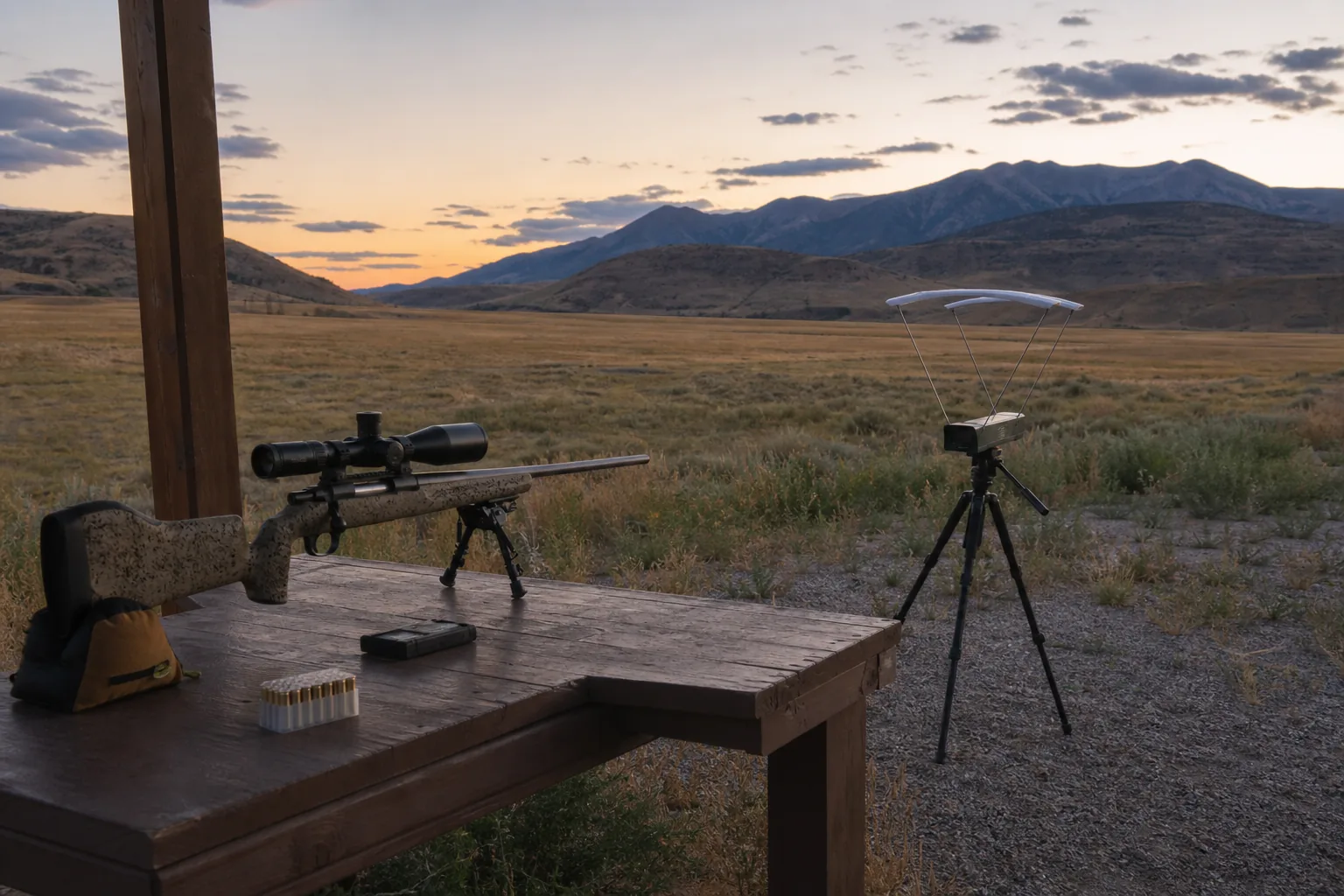
A shooting chronograph measures the real muzzle velocity of your loads in feet per second (fps). That number — and the consistency behind it — is the power behind every ballistic calculation you trust in the field. Without it, your drop data is built on a manufacturer’s test barrel, not on your setup.
01What does a chronograph for shooting actually measure?
A chronograph for shooting measures the speed of a projectile as it leaves the barrel, reported in feet per second. Run a string of rounds and it also gives you the consistency numbers that matter more than any single reading: extreme spread and standard deviation.
Most shooters first look at one number: muzzle velocity. It is the speed your load starts with, and every ballistic calculator needs it before it can predict where the bullet lands at distance. But one reading from one bullet is nearly useless on its own. The value of the tool shows up over a string of rounds.
Muzzle velocity, extreme spread, standard deviation: the numbers that matter
Think of it as a performance review of your cartridges, not a speedometer. Extreme spread tells you the worst-case swing across your rounds. Standard deviation tells you whether that swing is normal or an outlier. Different loads can share the same average velocity and behave very differently downrange, because the one with the tighter SD keeps its trajectory predictable bullet after bullet. That predictability is the entire point of a chronograph for a hunter: data you can trust when the window is short — and the season is long.
Insight: a single reading proves nothing; a string of ten proves a pattern. Takeaway: read the ES and SD columns, not just the average.
02Why muzzle velocity changes between the package and your barrel
Box velocity comes from a manufacturer’s test barrel. Your barrel length, the temperature, your altitude, and the specific lot of factory cartridges all shift the real number — in some cases by more than a hundred fps [A VERIFIER].
That is not a marketing trick. It is physics: a longer barrel gives propellant more time to burn and adds speed; cold air is denser and slows the round faster; thinner air at altitude reduces drag but can change pressure behavior; and different lots of factory cartridges do not burn identically. The number on the box is a controlled reference, measured under conditions that probably do not match your bench or your hunt.
| Factor | What changes | What it means for you |
|---|---|---|
| Barrel length | More barrel = more burn time, higher velocity | A velocity from a longer test barrel overstates your real number |
| Temperature | Cold lowers velocity, heat raises it | Drop data built in summer can miss in late-season cold |
| Altitude | Thinner air changes drag and pressure behavior | Mountain hunts deserve data measured closer to that altitude |
| Cartridge lot | Lot-to-lot variance in powder and components | A fresh lot can shift your point of impact |
The practical consequence is simple: your ballistic calculator is only as good as the velocity you feed it. Feed it a printed number and you are guessing at every range beyond your zero. Feed it a measured average from your own setup and the predictions have a real foundation. By now, one thing should be clear — the printed number is a starting point, never the final answer.
Insight: the label rarely lies — it just measures somewhere else. Takeaway: measure your own string if you want your own drop data.
03Sky screens, radar, or barrel-mounted: how each chronograph type works
Chronographs fall into three mechanisms: optical sky screens that time a round passing between a pair of light sensors, doppler radar that tracks the bullets in flight, and barrel-mounted units that sense the round at the muzzle. Each handles light, weather, and setup differently.
| Type | How it measures | Field strength | Limits |
|---|---|---|---|
| Sky screen | Light sensors time the round between two spaced screens | Simple, affordable, proven; the classic bench tool | Fussy about direct sun and alignment; a bad shadow or rain can drop readings |
| Doppler radar | Radar tracks the bullets in flight and records the speed curve | Works in sun, cloud, and light weather; no precise alignment downrange | Higher cost; more to learn; needs a clear line of flight |
| Barrel-mounted | A sensor attaches near the muzzle and reads each round as it passes | Quick setup, no downrange unit to trip over | Adds weight at the muzzle; can be sensitive to mounting and muzzle devices |
If you only shoot at a covered position in good light, a sky screen unit has served shooters for decades. If you hunt from a truck to a ridgeline and want data in whatever weather shows up, a radar unit removes most of the environmental excuses. If you want velocity with the least setup, a barrel-mounted unit gets you there fastest. Each mechanism is a different window into the same measurement, and the right one depends on where and how you shoot.
The second misconception: a chronograph is not only for handloaders. Hunters shooting factory cartridges need the same data. If you do not reload, you still need a measured velocity for a reliable drop table — you are simply verifying what the factory gives you instead of building your own load.
Insight: the mechanism defines the conditions you can measure in. Takeaway: match the mechanism to your terrain before you match it to your budget.
04How to use a chronograph: from shot string to a usable drop table
The workflow is: set up safely downrange, shoot a consistent string of at least ten shots, log the velocities, compute ES and SD, feed the average into a ballistic calculator, then confirm with a real-world drop test at range.
- Set up safelyPlace the unit on a tripod or stable rest downrange, with a clear line of flight, following the manufacturer’s spacing and the range’s safety rules. No exceptions on the safety side.
- Shoot a clean stringAt least ten shots, same position, same cartridge lot, same conditions. Cold-clean, fouled, or mixed lots corrupt the sample.
- Log every readingWrite down each velocity. Compare the results across the string before you trust any single number.
- Compute ES and SD, feed the averageDrop outliers you can explain (a bad reading, a flinch). Use the average of the clean string in your ballistic calculator.
- Confirm in the fieldVerify at a known range — your zero and a spot or two beyond. Data that does not match reality gets corrected, not ignored.
A common mistake is building a drop table from a short string. A short string can produce an average that looks fine and an SD that means nothing. Ten shots give you a distribution you can actually use, and it’s the distribution — not the average alone — that tells you whether your load is trustworthy at distance. By the end of the string, you have a sample worth trusting.
Insight: a clean string is the condition for a reliable drop table. Takeaway: shoot ten, log all of them, and confirm on the ground before the season depends on it.
05What to look for in a chronograph for shooting
Choose by mechanism first, then by how it handles the conditions you actually shoot in: direct sun, rain, cold, and how much setup you want at the range. Budget is the last filter in the purchase decision, not the first.
| If you shoot mostly… | Start with | Why |
|---|---|---|
| At a fixed range position, good light, covered position | Sky screen | Simple and proven for controlled conditions; easiest on the wallet |
| In backcountry, variable weather, quick setups | Doppler radar | Fewer environmental excuses; no precise downrange alignment |
| Want velocity with minimal setup at the range | Barrel-mounted | Fastest to deploy; no unit to place downrange |
Beyond the mechanism, look at the details that decide whether the tool earns its place in your pack: build quality for field use, battery life, power source, and how it records data (onboard memory or a Bluetooth phone app), and how easy it is to read in low light. Accuracy claims are worth checking against real user reports rather than spec sheets alone [A VERIFIER]. The important part is repeatability in your conditions, not a spec-sheet number. A decent unit, used and stored properly, is the kind of gear you still own in ten years. That is the high-ticket mindset: buy the mechanism that fits your hunting, not the one with the biggest marketing number.
The third misconception: the most expensive unit is the most suitable. A radar unit is wasted on a shooter who never leaves the covered position; a sky screen is a frustration in a rainy late season. Price does not equal fit.
When you start looking at the market, filter by terrain first, then mounting, then budget — in that order. Most competitors start with product rankings; start with your terrain instead. If you are assembling a precision hunting kit, our chronograph collection walks through the options side by side, with the same field-first filtering we apply to every optic we carry.
Insight: the decisive criterion is repeatability in your conditions, not the price tag. Takeaway: filter by terrain, then mounting, then budget — in that order.
Chronograph for shooting: FAQ
Do I need a chronograph for hunting?
If you shoot at distances beyond your zero or rely on a ballistic calculator, yes — the calculator is only as accurate as the velocity you enter. Hunters shooting factory cartridges need real measured data just as much as handloaders do. For close-range hunting where you never dial past a couple hundred yards, it’s a nice-to-have rather than a requirement.
How accurate are shooting chronographs?
Accuracy depends on the mechanism, the calibration, and the conditions. Sky screens are sensitive to lighting and alignment; radar units tolerate weather better; barrel-mounted units depend on a clean mount. Exact accuracy figures vary by model [A VERIFIER] — use spec-sheet claims as a starting point and verify against real user reports and a known reference load.
What is the difference between a radar and a sky screen chronograph?
A sky screen chronograph times the round between a pair of light sensors set a known distance apart — simple and proven, but sensitive to sunlight and alignment. A radar chronograph tracks the bullets in flight and records the speed continuously — it handles changing light and weather better and needs less precise downrange setup, at a higher cost. Choose by the conditions you actually shoot in.
- Wikipedia — “Chronograph”: en.wikipedia.org/wiki/Chronograph (accessed August 2026).
- Search demand: “chronograph for shooting” — estimated 1,300 US searches per month, keyword difficulty 22% (Easy), Semrush estimate, US database, August 2026. Presented as a third-party estimate, not an exact measurement.
- Velocity variation figures (barrel length, temperature, altitude, lot) are generic technical knowledge; specific magnitude shown as [A VERIFIER] pending a citable primary source.


