
Long Range Shooting Chronograph: Radar vs Optical Screens
Your ballistic solver is only as good as the velocity you feed it. Here is what a chronograph actually measures, why radar replaced optical screens for precision work at distance, and what the LabRadar really delivers on the bench.
What Does a Chronograph Actually Do?
Your barrel does not know its own velocity. The factory lists a number on the box, but every lot of cartridges, every barrel length, and every temperature shifts the real figure. A chronograph replaces that assumption with a measurement. Feed the correct velocity into your solver and the solution it returns is worth trusting; feed it a guess and every click of elevation is a guess too.
Muzzle velocity is the input every ballistic solver needs
Ballistic software works like a simple equation: velocity, ballistic coefficient, altitude, temperature, and wind go in; a drop solution comes out. Get the velocity wrong by 50 fps and the error compounds downrange. The chronograph also measures variation — extreme spread (ES) and standard deviation (SD) across a string of shots. Two batches can share the same average velocity yet behave very differently at distance, because the batch with the tighter ES keeps your impacts clustered. It’s the variation data that separates a pro load developer from a shooter guessing at charge weights — the impact of a wrong velocity input grows with every yard of drop.
- Real muzzle velocity per load, not the number printed on the box.
- Extreme spread and standard deviation across a shot string.
- Trustworthy inputs for every drop chart and ballistic app you use.
Reading the numbers takes a minute. A string of ten shots produces a mean velocity, an extreme spread (the gap between the slowest and fastest shot), and a standard deviation (how tightly the values cluster around the mean). For precision work, the ES and SD matter more than the mean itself: a charge that averages 2,800 fps but swings 40 fps between shots will open up well before a charge that averages 2,790 fps with an SD of 6. The chronograph turns that judgment from a hunch into a comparison you can actually see.
Optical Screens vs Radar: Why Shooters Switched
For decades the standard tool was an optical chronograph: two light screens mounted on a gate, and the bullet breaks the first beam, then the second, and the unit computes the time between them. It works, and plenty of shooters still use entry-level units from brands like Caldwell. The friction is what pushed shooters toward radar. You have to shoot through the gate, which means a stray shot destroys the unit. You align screens, level them, and often wait between shots. A radar chronograph removes that entire workflow.
| Point of comparison | Optical screens | Radar chronograph |
|---|---|---|
| Setup | Screens on a gate, leveled and wired, bullet passes through them | Unit behind the firing line on its stand, aimed at the lane |
| Measurement | Time between light beams broken by the bullet | Doppler radar tracks the projectile in flight |
| Shot flow | One shot at a time through the gate | Full series without touching the unit |
| Tracking envelope | A few feet in front of the muzzle | Up to 100 yards downrange |
| Main risks | Shoot-through damage, alignment drift, ambient light issues | Battery, mount stability, clear line of sight |
A third family sits between them: magnetic barrel sensors, of which the Magnetospeed line is a well-known example. The sensor clamps onto the barrel and measures the projectile as it passes the muzzle. The reading is reliable and the setup is simple, but the sensor adds weight near the muzzle, which changes barrel harmonics — a real concern when you are working up a precision load. Radar sidesteps that entirely because nothing touches the barrel. Entry-level optical chronographs like Caldwell still have a place for casual velocity checks, but they keep the shoot-through gate that radar removed.
Honest caveat: radar did not make measurement magic. It removed friction — no gate to shoot through, no cables between shots, and a whole string captured at once. For a shooter who develops loads in strings of ten, that is the practical difference.
What the LabRadar Doppler Chronograph Measures
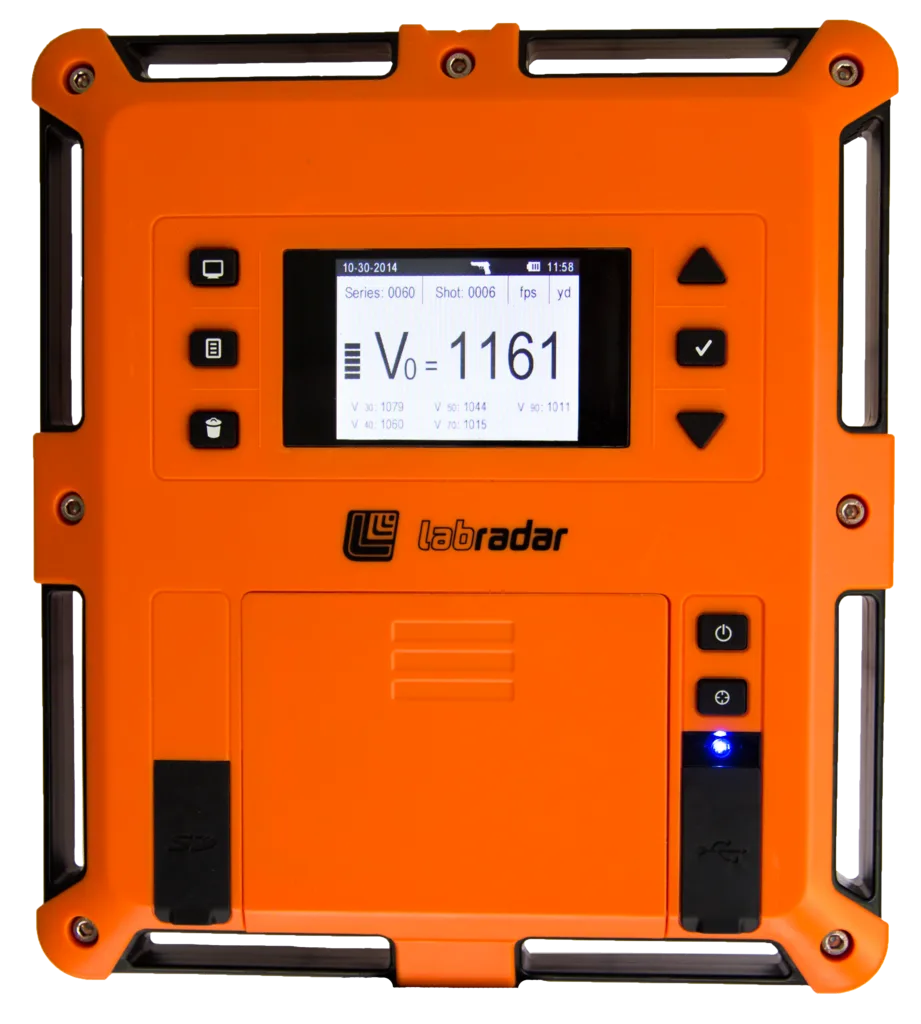
The unit is a Doppler radar: it sends a radar wave toward the shooting lane and reads the frequency shift of the returning signal as the projectile travels. Because nothing sits in the bullet’s path, you can record a full string without resetting anything. The published specifications, from the HuntPremium product page, are:
| Specification | Value |
|---|---|
| Velocity range | 65 to 3,900 fps |
| Accuracy | 0.1% |
| Max tracking range | Up to 100 yards |
| Shots per series | Up to 100 |
| Series capacity | 9,999 |
| Power | Six AA batteries |
| Data export | USB or SD card |
| Mount | Tripod |
| Price | $559.95 |
Two numbers matter most for precision work. The 0.1% accuracy means the velocity reading is a measurement, not an estimate. And the up-to-100-yards tracking envelope is the feature optical screens cannot match: because the radar keeps reading the projectile downrange, you can spot velocity behavior beyond the muzzle — a useful signal when a charge starts showing instability. That downrange view is the angle most chronograph articles skip entirely.
What the velocity data tells you
Once the unit has recorded a series, the useful work starts. The display gives you the velocity of every shot, plus the mean, extreme spread, and standard deviation for the string. Check those three values before you trust a load: a tight mean with a wide ES means your powder charge is not consistent, while a clean ES with a drifting mean points to a temperature or lot change — different lots of the same cartridge can vary more than you expect. The 9,999-series capacity matters here: it means you keep a permanent record of every load you have ever tested, not just today’s numbers. Compare the velocities across a string and you will spot a flier immediately instead of blaming the optics.
Because the radar tracks the projectile beyond the muzzle, it also behaves cleanly with suppressors: nothing is mounted on the barrel, so the suppressor and the muzzle blast do not interfere with the sensor. It is one less compatibility question when you set up a suppressed precision rig, and it covers large calibers as easily as small ones within the 65-to-3,900-fps band.
HuntPremium is an authorized LabRadar dealer and stocks the LabRadar Ballistic Velocity Doppler Radar Chronograph at $559.95, with the matching Mini Tripod (7″ to 18″) and Padded Carrying Case available separately.
Setting Up a LabRadar at the Range
- Mount the unit on a stable stand. The LabRadar Mini Tripod extends from 7 to 18 inches and is built for this unit.
- Position it behind the firing line, radar facing your shooting lane, with a clear line of sight downrange.
- Start a series on the unit.
- Shoot your string. The unit records each shot — up to 100 per series — without needing a reset between rounds.
- Review the data on the display: velocity, extreme spread, and standard deviation for the string.
- Export when needed via USB or SD card for a full session log.
The practical payoff is speed: a ten-shot string that used to mean ten individual passes through an optical gate now runs as one uninterrupted series. That is what makes the radar chronograph a bench tool rather than an extra chore — a pro-grade unit earns its spot on the bench because it saves minutes on every series. Keep the mount level and the lane clear, and the unit does the rest.
What to Look for in a Chronograph
- Accuracy: 0.1% is the reference figure; the reading has to be a measurement, not a guess.
- Tracking envelope: the bigger the tracking envelope, the more downrange behavior you see.
- Shots per series: load development runs in strings; a 100-shot series removes the reset friction.
- Data export: USB or SD export lets you analyze ES and SD after the session, not just on the display.
- Power source: six AA batteries mean no cables and no bench power brick.
Two other features deserve a look depending on how you work. App or Bluetooth integration is convenient when you want to pull a session into a phone or tablet without hunting for a cable — check whether the unit you are considering supports it. And if you shoot in variable field conditions, look at how the unit handles weather: a radar chronograph has no exposed screens, which removes one set of weather-related failures entirely.
For a serious hunter shooting at distance, the purchase decision comes down to one question: does this tool give me velocity data I can trust, string after string? Pro shooters compare accuracy, tracking envelope, and series capacity before anything else — the LabRadar answers with a published accuracy of 0.1%, a 100-yard tracking envelope, and a 100-shot series capacity, the specifications a load developer actually uses. Compare the full LabRadar chronograph lineup at HuntPremium to see the accessories and options that fit your bench setup.
FAQ
Is a chronograph worth it for long range shooting?
Yes, if you develop loads. Without real velocity, your drop table and ballistic solver start from a guess, and the error grows with distance. A chronograph gives you the measured velocity and the extreme spread across a string, which is the data that actually drives group size at distance. It pays for itself the first time it keeps you from chasing a load that was fine all along.
How accurate is a radar chronograph?
The LabRadar Ballistic Velocity Doppler Radar Chronograph publishes 0.1% accuracy. In practice, that means the velocity you record is a measurement rather than an estimate, and the readings stay consistent across a string of shots. Accuracy and tracking envelope are the two specifications to compare before buying any chronograph.
What is the difference between optical and radar chronographs?
An optical chronograph measures the time between light beams as the bullet passes through a gate a few feet in front of the muzzle. A radar chronograph uses Doppler radar to track the projectile in flight, with nothing in its path, and can record a full series of shots without resetting. Radar also tracks further downrange — up to 100 yards for the LabRadar.
Can the LabRadar store and export shot data?
Yes. The unit stores up to 100 shots per series and 9,999 series, and exports data through USB or an SD card. That makes it straightforward to build a session log, calculate extreme spread and standard deviation on a computer, and keep a record of every load you have tested.
Does the LabRadar include a tripod or batteries?
The unit runs on six AA batteries and mounts on a stand. At HuntPremium, the LabRadar Mini Tripod (7″ to 18″) and the Padded Carrying Case are sold separately, alongside the chronograph itself.
How many shots can the LabRadar record in a session?
The LabRadar records up to 100 shots per series and keeps up to 9,999 series in memory. In practice that covers a full day of load development: shoot a string, review the mean, ES, and SD, then start the next series without clearing anything.
Does a radar chronograph work with a suppressor?
Yes. Because the unit sits behind the firing line and nothing mounts on the barrel, a suppressor does not interfere with the measurement. The radar tracks the projectile in flight the same way it would on an unsuppressed setup.
- HuntPremium — LabRadar Ballistic Velocity Doppler Radar Chronograph, product page consulted August 2026 (specifications and price).
- HuntPremium — Chronographs collection.
- Chronograph, Wikipedia, consulted August 2026.
- SEMrush keyword overview, US database, August 2026 (estimated search volume, third-party estimate).
HuntPremium is a US retailer and authorized dealer for LabRadar, built on the promise “Gear That Earns Its Spot.” Every product in the catalog is vetted for build quality, real-world performance, and warranty support. Nothing in this guide is sponsored or invented; specifications come from the manufacturer and the HuntPremium product page.


