
Hunting Base Layer Buying Guide: Merino vs Synthetic
The layer against your skin decides whether you stay warm and dry on a long sit or end the day cold and clammy. This hunting base layer buying guide breaks down merino, synthetic, and blends by how they actually work.
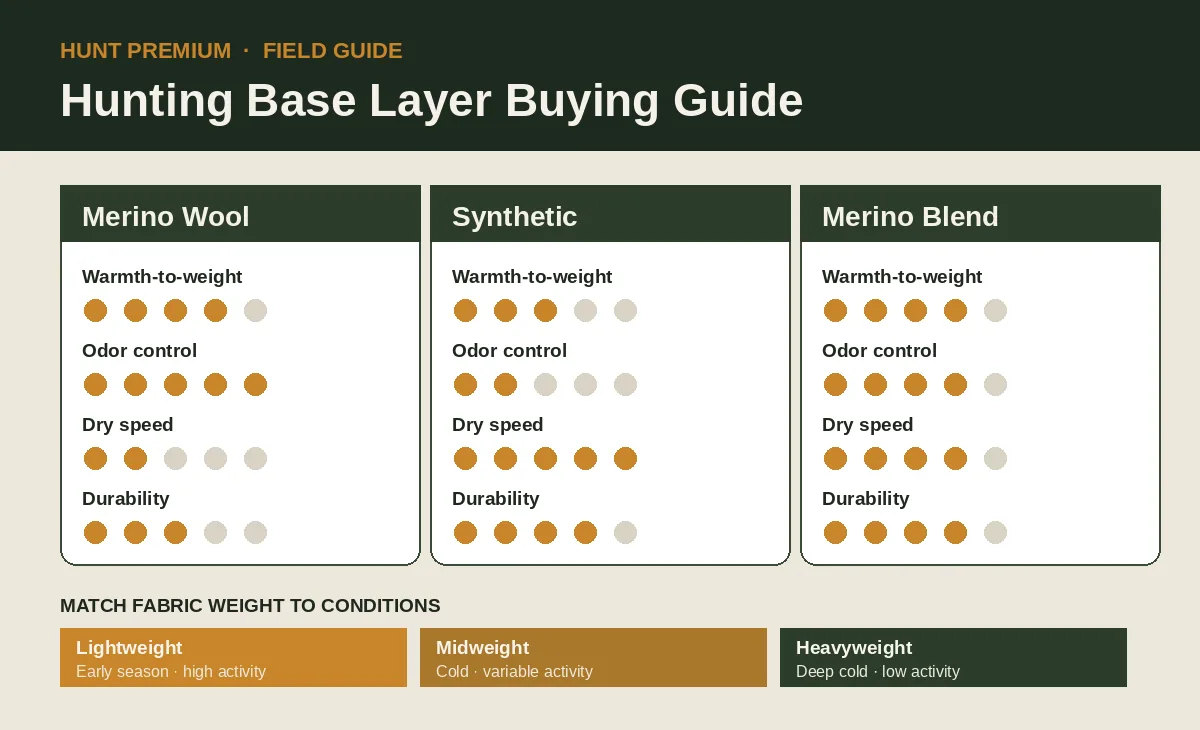
A hunting base layer is the next-to-skin garment that moves sweat off your body and holds a thin layer of warm air. Merino wool base layers resist odor and stay warm when damp; synthetic base layers dry faster and shrug off abrasion; a merino-synthetic blend splits the difference. Match the fabric weight to your temperature and output level, not the label.
01What a hunting base layer actually does
A base layer has one job: manage the moisture and heat right at your skin so the rest of your clothing can do its work. It sits under your insulation and shell layers and controls the microclimate against your body — wicking sweat outward and trapping a thin cushion of warm air. Get this layer wrong and no jacket saves you.
The reason it matters so much on a hunt is simple: you alternate between hard effort and long stillness. You perspire on the climb in, then sit motionless for hours. Wet fabric against the skin pulls heat away fast — the National Weather Service notes that wet clothing accelerates body-heat loss and raises cold-weather risk (NWS cold safety, accessed July 27, 2026). A good base layer keeps that sweat moving so you stay dry through the swing from active to still.
So the criteria that matter are concrete: how the material wicks moisture, how much warmth it gives for its weight, how it manages smell over an extended trip, how fast it dries, and how it fits against the skin. The rest of this hunting base layer buying guide walks each one in the order a buyer actually decides.
- The base layer manages sweat and warmth at your skin — it sets up everything worn over it.
- Wet fabric against skin drains body heat quickly, which is why moisture control comes first.
- Material and fabric weight are the two decisions that actually change performance.
02Merino wool vs. synthetic vs. blend
The material decides the trade-offs. Merino wool wins on warmth-when-damp and natural odor control; synthetic (usually polyester) wins on dry speed and durability; a merino-synthetic blend keeps most of the wool comfort while adding abrasion resistance. There is no single winner — there is a right pick for how you hunt.
Merino is a fine natural wool. Its fibers are noticeably thinner than standard wool — fine merino generally measures under 24 microns in diameter (Merino, Wikipedia, accessed July 27, 2026), which is why it feels soft rather than scratchy against the skin. Those fine fibers also hold warmth even when they take on moisture, and the wool structure naturally slows the odor-causing bacteria that build up over a multi-day hunt.
Synthetic base layers use engineered polyester (sometimes with a little stretch fiber). They move sweat off the skin quickly and dry fast, and they take repeated washing and pack abrasion without thinning out. The trade-off is odor: bare polyester holds smell faster than wool, so many polyester base layers add a treatment to control smell. A merino-synthetic blend fabric is the middle path — wool next to the skin for comfort and odor resistance, synthetic content for faster drying and longer life.
| Attribute | Merino wool | Synthetic (polyester) | Merino-synthetic blend |
|---|---|---|---|
| Warmth when damp | Holds warmth as it absorbs moisture into the fiber | Warmth drops faster once saturated | Retains most of merino’s warm-when-damp behavior |
| Dry speed | Slower — wool absorbs before it releases | Fast — moves water to the surface to evaporate | Faster than pure wool, slower than pure synthetic |
| Odor control | Natural — fiber slows odor bacteria | Needs a treatment to match wool | Strong — wool content carries the odor resistance |
| Durability / abrasion | Softer fiber wears faster at pack points | High — resists thinning and snags | Improved over pure wool from the synthetic content |
| Ideal conditions | Cold, low output, extended trips | High-output, wet, hard-use outings | Variable conditions and mixed activity |
03Fabric weight: matching warmth to conditions
Fabric weight sets the warmth, and it matters as much as material. Base layers are sold by fabric weight in grams per square meter — lightweight for warm weather and high output, midweight for general cold-weather use, and heavyweight for deep cold and long sits. Buy the weight for the temperature and exertion you actually face, not the coldest day you can imagine.
The logic is about heat balance. A lightweight fabric moves sweat fast and vents warmth, which is what you want when you are moving hard and generating your own warmth. A heavyweight fabric traps more warm air for when you are still and the temperature drops, but it will cook you on a hard climb. Most hunters who cover a range of conditions get more use from a midweight top than from either extreme.
Early season, warm weather, high activity. Vents heat and dries fast when you are working hard and sweating.
General cold and variable effort. The most versatile weight for hunters who move, then sit, across changing conditions.
Deep cold and long, low-output sits. Maximum warmth per layer, but too warm for hard exertion.
One practical note on fit and weight: base layer bottoms follow the same rule as tops. A lightweight bottom under pants covers most active hunts; a midweight or heavyweight bottom earns its place on cold, stationary sits. Buying two weights — one light, one mid — covers more of the season than a single heavy set that only fits the coldest week.
04Moisture, odor control, and fit
Beyond material and weight, three performance details separate a base layer that works from one that just adds bulk: how it manages moisture, how it controls odor over days, and how it fits. These are the traits you notice on hour six, not in the store.
Moisture management is the whole point. The material has to pull sweat off the skin and pass it to the outer layers to evaporate. Synthetic fibers do this fastest; merino does it more slowly but keeps you warm while it happens. Either way, the goal is the same — keep liquid water off your skin so you do not chill when you stop moving.
Odor control is what makes multi-day trips bearable. Merino’s fiber structure naturally slows the bacteria that cause smell, so a wool or blend top remains wearable for a long stretch between washes. Synthetic layers rely on an added treatment to get close. If you hunt hard for a long stretch without laundry, odor resistance is a real buying criterion, not a luxury.
Fit decides whether the material can do its job at all. A base layer should sit close to the skin without squeezing — snug enough to wick, loose enough to trap a thin air layer and move freely. A baggy base layer leaves gaps that hold cold air; an over-tight one restricts movement and compresses the insulating loft. Look for a long back hem and cuffs that stay put under other layers.
Two more factors round out the decision: how a layer feels and what it costs. Merino tends to feel softer against the body on long wears, though a quality merino piece is often more expensive than a comparable option. Synthetics and blends are typically more durable at stress points and priced lower, so the value question is real. A great choice is the one you will actually reach for across a range of temperatures — especially if you hunt only a handful of weekends a year rather than a full backcountry season.
05Building a layering system that works
The base layer is one part of a three-part system: base, mid, and outer. Each layer has a distinct job, and the setup only works when all three cooperate. The base wicks and holds warmth, the mid layer insulates by trapping air, and the outer layer blocks wind and rain. Skip or overload any layer and the whole setup falls short.
The reason the base layer sits at the center of the system is heat and moisture flow only outward if the layer against your body starts the process. When the base wicks well, the mid layer stays dry and keeps insulating; when it fails, sweat soaks the insulation and the whole stack chills through. That is why hunters who care about staying comfortable start their gear decisions here, at the skin, and build out.
06How to choose the right base layer for your hunt
Choosing comes down to three questions: how cold, how hard you move, and how long you are out. Answer those honestly and the material and weight fall into place. A high-output early-season hunt points to lightweight polyester; a cold, multi-day backcountry sit points to midweight or heavyweight merino or blend; mixed conditions point to a midweight blend that covers the most ground.
Here is the practical decision path. If you sweat hard and move constantly, prioritize dry speed — a lightweight synthetic or blend. If you sit still in the cold for hours, prioritize warmth-when-damp and buy up in weight — merino or a merino-heavy blend. If you hunt a long stretch without laundry, weight the choice toward wool for smell control. Most hunters who hunt a full season end up with two layers: a light one for warm, high-output hunts and a midweight for cold sits.
One honest caveat: this gear is an investment, and a base layer is not where to cut corners, because it sets up everything worn over it. HuntPremium is a US-based hunting retailer that carries base layers vetted for real field use, and we would rather point you to the right weight and material for your hunt than sell you the warmest option by default. If you are between choices, our team can talk through your conditions before you commit — see why hunters buy from us or reach the team directly. You can also browse the wider HuntPremium hunting gear shop to complete the setup.
A last practical point is care. Follow the wash guidance on the label, use a gentle cycle, and air dry when you can. High-heat drying is often what shortens a garment’s life, so treating a layer gently keeps it performing and comfortable across many seasons of use.
07Frequently asked questions
Which material suits a hunting base layer?
There is no single right material — it depends on your hunt. Merino wool suits cold, low-output trips over several nights because it stays warm when damp and resists smell. Polyester suits high-output, wet, hard-use trips because it dries fast and resists abrasion. A merino-synthetic blend covers variable conditions.
Is merino or synthetic better for a hunting base layer?
Merino is better when you sit still in the cold or head out for a long stretch without washing, thanks to warmth-when-damp and natural odor control. Polyester is better when you move hard and perspire, because it dries faster and takes more abuse. A blend keeps most of merino’s comfort while drying quicker and lasting longer.
What weight base layer do I need for cold-weather hunting?
Match fabric weight to temperature and exertion. Lightweight suits warm weather and high output, midweight covers general cold and mixed use, and heavyweight is for deep cold and long, still sits. For most hunters who move then sit, a midweight base layer is the most versatile single choice.
Can I wear a hunting base layer as an outer layer?
No. A base layer is built to sit against the skin and move moisture into the layers over it. Worn alone it has no wind or rain protection and little insulation. It works as the first layer in a base-mid-outer system, where the mid layer insulates and the outer layer blocks weather.
How should a hunting base layer fit?
Snug but not tight. The fabric should sit close to you so it can wick moisture, while still letting you move and trapping a thin layer of warm air. Baggy base layers leave cold gaps; over-tight ones restrict movement and compress insulation. Look for a long hem and secure cuffs that stay put under other layers.
Do I need base layer bottoms as well as a top?
For cold or long, stationary hunts, yes. Base layer bottoms manage moisture and warmth on your legs the same way the top does for your core. On milder, high-output hunts a lightweight bottom or none at all may be enough. Match the bottom’s weight to conditions, just as you do the top.
How many base layers should a hunter own?
Most hunters who hunt a full season are well served by two: a lightweight layer for warm, active days and a midweight for cold sits. That pairing covers a wider range of conditions than a single heavyweight set, which only fits the coldest, least active days of the year.
- Merino — fiber characteristics and fineness. Wikipedia. Accessed July 27, 2026. en.wikipedia.org/wiki/Merino
- Cold Weather Safety — body-heat loss and wet clothing. National Weather Service (NOAA). Accessed July 27, 2026. weather.gov/safety/cold


